
research paper
Lamp Designs and Attention Fields: Ambient Computing for Agentic AI
– Ian Gonsher, Jialong Lai, Runan Wang, Ruijia Diao, Shaivi Tomar
Abstract
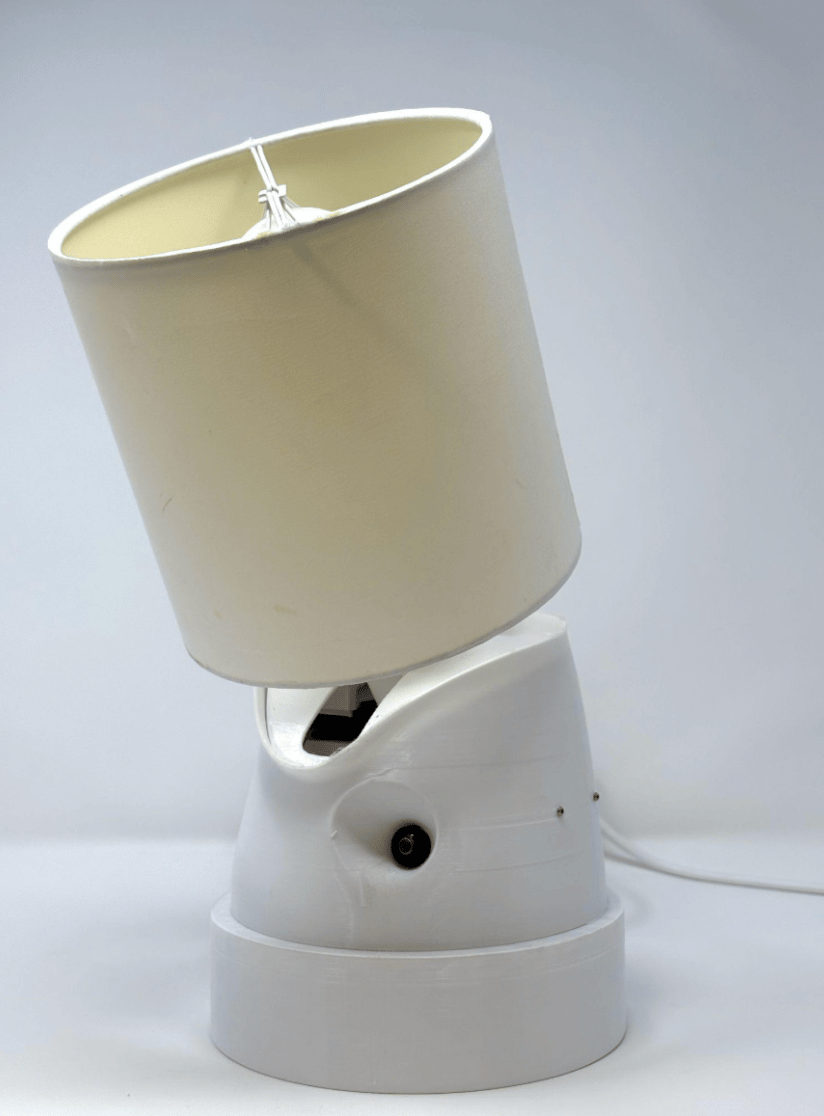
As artificial intelligence becomes integrated into an increasing number of everyday objects, our relationships with these objects will inevitably evolve. The built environment—including architecture, furniture, and even the lighting that shapes much of our lived experience—offers new opportunities to reconsider how we interact with everyday objects. As with other emerging AI-enabled technologies, these objects may shape our attention in fundamental ways. This design research project asks: How might objects that hide in plain sight initiate meaningful interactions with users and appropriately calibrate users’ attention while still fulfilling their conventional role as furniture? To explore this question, we developed a series of lamp prototypes that use light and movement to initiate attention within a given space. We speculate about the development and proliferation of “Attention Fields,” in which objects situate themselves as constellations of AI-embodied artifacts that respond to the presence of users within a space.
Keywords
Embodied interaction, Attention, Interactive environments, Ambient interfaces, Computer vision, Human systems integration, Ambient computing
research paper
Lamp Designs and Attention Fields: Ambient Computing for Agentic AI
– Ian Gonsher, Jialong Lai, Runan Wang, Ruijia Diao, Shaivi Tomar
Abstract
As artificial intelligence becomes integrated into an increasing number of everyday objects, our relationships with these objects will inevitably evolve. The built environment—including architecture, furniture, and even the lighting that shapes much of our lived experience—offers new opportunities to reconsider how we interact with everyday objects. As with other emerging AI-enabled technologies, these objects may shape our attention in fundamental ways. This design research project asks: How might objects that hide in plain sight initiate meaningful interactions with users and appropriately calibrate users’ attention while still fulfilling their conventional role as furniture? To explore this question, we developed a series of lamp prototypes that use light and movement to initiate attention within a given space. We speculate about the development and proliferation of “Attention Fields,” in which objects situate themselves as constellations of AI-embodied artifacts that respond to the presence of users within a space.
Keywords
Embodied interaction, Attention, Interactive environments, Ambient interfaces, Computer vision, Human systems integration, Ambient computing